
Becoming a licensed private investigator requires meeting your state’s minimum age, background, and experience requirements, then applying through the state licensing board. Most states require 2–5 years of investigative experience, though education in criminal justice can substitute for part of that requirement. Licensing rules vary significantly by state.
Private investigators work fraud cases for insurance carriers, dig up evidence for defense attorneys, track assets in civil litigation, run background investigations for corporations, and yes — still handle the infidelity cases that gave the profession its reputation. The work is more varied and more technically demanding than it looks from the outside, and getting licensed to do it requires navigating a patchwork of state-level requirements that don’t follow a single national standard.
According to the Bureau of Labor Statistics, private investigators earned a median annual salary of $52,370 as of May 2024. The BLS projects 6% employment growth for the occupation between 2024 and 2034, with an average of 3,900 job openings per year—a solid outlook for a field expanding into digital forensics, cybercrime support, and corporate compliance work.
Here’s how the licensing process works, step by step.


Find Info For Your State
- Alabama
- Alaska
- Arizona
- Arkansas
- California
- Colorado
- Connecticut
- Delaware
- District of Columbia
- Florida
- Georgia
- Hawaii
- Idaho
- Illinois
- Indiana
- Iowa
- Kansas
- Kentucky
- Louisiana
- Maine
- Maryland
- Massachusetts
- Michigan
- Minnesota
- Mississippi
- Missouri
- Montana
- Nebraska
- Nevada
- New Hampshire
- New Jersey
- New Mexico
- New York
- North Carolina
- North Dakota
- Ohio
- Oklahoma
- Oregon
- Pennsylvania
- Rhode Island
- South Carolina
- South Dakota
- Tennessee
- Texas
- Utah
- Vermont
- Virginia
- Washington
- West Virginia
- Wisconsin
- Wyoming
Step 1. Understand How State Licensing Works
Private investigators are licensed at the state, not the federal, level. That means there is no single national PI license — each state sets its own requirements, runs its own licensing board, and enforces its own rules about who can conduct investigations and under what conditions.
Most states operate their PI licensing through a dedicated board or bureau, often housed within a larger public safety or commerce agency. Texas licenses its private investigators through the Private Security Board within the Texas Department of Public Safety. In Tennessee, PIs are licensed by the Private Investigative and Polygraph Commission, part of the Department of Commerce and Insurance. Your first step is to find out which agency controls licensing in your state.
A few states recognize limited interstate investigative work through reciprocity arrangements, which can allow a PI licensed in one state to conduct investigations in another without obtaining a separate license — provided the case originates in the investigator’s home state. These agreements change frequently and should be verified directly with each state licensing board before you rely on them.
Even in states without a statewide licensing requirement — Alabama is the most commonly cited example — individual cities may require licensing, and all states impose regulations on privacy, impersonation of law enforcement, and business operations for PI firms. No state is a free-for-all.
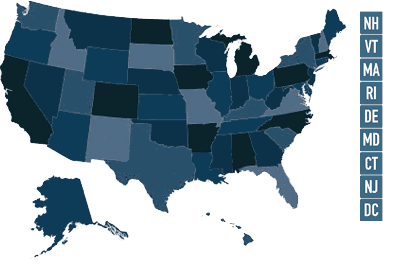
Use the state map above or browse our state-by-state licensing guide to find the specific requirements where you plan to work.
Step 2. Meet the Minimum Requirements
Before you can apply for a PI license, you need to meet a baseline set of eligibility criteria. These vary by state, but the core requirements follow a consistent pattern across most jurisdictions.
Most states require candidates to:
- Be at least 18 to 25 years old (age minimum varies by state)
- Be a U.S. citizen or legal resident
- Hold a high school diploma or GED
- Have no felony convictions or convictions involving moral turpitude
- Have no dishonorable discharge from the U.S. military
These are UShold requirements — you need to clear them before the experience and education requirements even come into play.
Step 3. Meet Education and Experience Requirements
This is where requirements diverge most sharply between states. A handful of states set no formal education requirement at all. Others require a degree in criminal justice or a related field. Most fall somewhere in between — they don’t mandate a degree, but they do require documented investigative experience, and they’ll let you substitute education for part of it.
New Hampshire is a good example of how the substitution model works: the state requires four years of investigative experience for licensure, but candidates with an associate’s or bachelor’s degree in criminal justice can substitute their education for two of those four years.
Qualifying experience typically includes work as a law enforcement officer at the federal, state, or local level; military service in an intelligence or investigative role; work as an insurance claims investigator or adjuster; corporate security director; or risk manager. If you’re coming from a law enforcement or military background, there’s a good chance your existing experience gets you most of the way there. Our private investigator career guide covers how different backgrounds translate into PI work.
If you’re starting without that background, pursuing a criminal justice degree while building relevant work experience is the most reliable path. Browse PI schools and programs by state to see what’s available in your area.
Step 4. Pass the State Licensing Exam
Some states require candidates to pass a jurisprudence examination before they can be licensed. These exams are typically taken after submitting a license application and cover state-specific laws and procedural rules governing PI work — surveillance protocols, privacy law, what constitutes legal evidence collection, and how to operate a PI business within the state’s regulatory framework.
Not every state requires a written exam, but where it’s required, passing it is non-negotiable. Check your state’s licensing exam requirements to find out what’s on the test and how it’s administered.
Step 5. Complete Firearms Training (If Applicable)
PIs aren’t required to carry a weapon, and many choose not to. But in states that permit investigators to carry a firearm on the job, candidates seeking that authorization must complete mandatory firearms training and hold a valid concealed carry license in their state.
Approved firearms training providers vary by jurisdiction and should be confirmed with the relevant state licensing authority. Application fees, training requirements, and renewal schedules for firearms certification vary by state — treat it as a separate licensing track from your PI license.
Step 6. Apply for Your State License
Once you’ve met the eligibility, experience, and exam requirements, you can submit your formal license application to the state licensing board. Most states require the following as part of that package:
- A completed, notarized application
- A full set of fingerprints for a background investigation
- Personal and professional references
- Documentation of your investigative experience
- Educational transcripts or diplomas (if applicable)
- Proof of a surety bond — most states require a minimum of $10,000
- Payment of application, license, fingerprint, and background check fees
Processing time varies considerably by state. Some boards turn applications around in a few weeks; others take several months. Plan for delays, especially if your background investigation requires additional follow-up.
Step 7. Maintain Your License
Licensing isn’t a one-time event. Renewal cycles commonly range from 1 to 3 years, depending on the state, and renewal typically involves a renewal application, an updated background check, and a current surety bond on file. Some states require continuing education hours for renewal. Firearms certification, where applicable, has its own renewal requirements separate from the base PI license.
Staying current on renewal deadlines and CE requirements is part of operating as a licensed investigator — a lapsed license creates real legal exposure.
Step 8. Consider Professional Certification
State licensure is required to practice as a PI. Professional certification is voluntary, but it carries weight with clients — particularly in corporate, legal, and insurance work where credentials matter.
The most recognized certifications in the field are offered through ASIS International and other professional associations:
- Professional Certified Investigator (PCI) — Offered by ASIS International. Focuses on investigative techniques, case management, evidence collection, and legal considerations. Requires documented investigative experience and passing a written exam.
- Certified Protection Professional (CPP) — Also through ASIS International. Broader security management credential covering risk assessment, investigations, and ethics. Well-regarded in corporate security contexts.
- Certified Fraud Examiner (CFE) — Offered by the Association of Certified Fraud Examiners. Relevant for investigators specializing in financial crimes, insurance fraud, or corporate fraud investigations.
- Certified Legal Investigator (CLI) — Administered by the National Association of Legal Investigators (NALI). Targeted toward PIs working with defense attorneys and civil litigators — covers legal research, evidence handling, and courtroom testimony.
None of these replaces your state license. They add a layer of credibility that can help you stand out in competitive markets or specialized practice areas. See our PI training and certification guide for more details on each.
Frequently Asked Questions
Do I need a degree to become a private investigator?
In most states, a degree isn’t required for licensure, but it can substitute for part of the experience requirement. If your state requires four years of investigative experience and you hold a criminal justice degree, you may be able to count two of those years toward the degree. Even where it’s not required, a degree in criminal justice, criminal investigation, or a related field gives you a working knowledge of evidence law, surveillance protocols, and investigative procedure that accelerates your development on the job.
How long does it take to become a licensed PI?
It depends heavily on your starting point. If you’re coming from law enforcement or the military with years of qualifying experience already on your record, the application process may take only a few months. If you’re starting from scratch and need to build the required experience first, you’re realistically looking at three to five years before you’re eligible to apply in most states. Some states offer apprenticeship pathways that let you work under a licensed PI while accumulating hours toward your own license.
What states don’t require a PI license?
Several states have historically not required statewide PI licensure, but state regulatory requirements change periodically and should always be verified before operating. Even in states without a statewide requirement, individual cities may impose local licensing rules, and all states have laws governing surveillance, privacy, and impersonation of law enforcement that apply to investigative work regardless of licensure status. Operating without a license in a state that requires one is a criminal offense in most jurisdictions.
How much do private investigators make?
According to the Bureau of Labor Statistics, private investigators earned a median annual salary of $52,370 as of May 2024. The top 25% earned $75,310 or more, and the top 10% exceeded $98,770 annually. Earnings vary significantly by specialty, location, and whether you’re working for an agency or running your own firm. See our private investigator salary guide for a full breakdown by state.
What skills do I need to become a private investigator?
Surveillance patience and attention to detail are the foundation — the work involves long stretches of observation and meticulous documentation. Beyond that, strong written communication matters enormously: reports and affidavits have to hold up in legal proceedings. Interviewing skills, familiarity with public records research, and working knowledge of digital tools (OSINT, database searches, basic digital forensics) are increasingly important in modern PI work: physical fitness and the ability to adapt quickly to unpredictable situations round out the core skill set.
Can I work as a PI in multiple states?
Only with the right licensing. Some states recognize limited interstate investigative work through reciprocity arrangements, but these agreements are fragmented, often conditional, and change frequently. If you plan to work regularly across state lines, the safest approach is to obtain licensure in each state where you’ll be conducting investigations. Verify current reciprocity status directly with each state’s licensing board before relying on it.
Key Takeaways
- Licensing is state-controlled — there’s no federal PI license; requirements, boards, and processes vary significantly from state to state.
- Experience is the main gate — most states require 2–5 years of qualifying investigative or law enforcement experience; education in criminal justice can substitute for part of that.
- A few states have no license requirement — but surveillance and privacy laws still apply everywhere, and local jurisdictions may impose their own rules.
- Reciprocity is limited and inconsistent — some states recognize limited interstate investigative work, but these arrangements change frequently and must be verified directly with each state’s licensing board.
- Professional certifications add credibility — PCI, CFE, and CLI credentials aren’t required, but they carry real weight in corporate, legal, and insurance investigations.
- The job market is growing — the BLS projects 6% employment growth for PIs between 2024 and 2034, with about 3,900 openings per year.
Ready to find a program? Browse PI schools and criminal justice programs by state to see what education options are available in your area.
May 2024 US Bureau of Labor Statistics salary and job market figures for Private Detectives and Investigators reflect state and national data, not school-specific information. Conditions in your area may vary. Data accessed May 2026.