Approximately 30 states require a written exam before you can get your PI license. Most test your knowledge of state laws and investigative procedures — called a jurisprudence exam. A smaller number also test practical PI skills. Find your state below for the exact format, passing score, and where to register.
Getting your PI license in most states means clearing one final hurdle before you can work independently: the state licensing exam. Approximately 30 states require you to pass an exam as a condition of becoming licensed, and a small number of additional states offer an exam as one optional route to licensure. What the exam covers, how hard it is, and where you take it all depend on your state.


State Jurisprudence Exam
The most common type is a state jurisprudence exam designed to confirm you understand state laws as they apply to private investigations work. There are a few reasons your state licensing board wants to verify this before issuing your license:
- To ensure you know the applicable laws that govern your practice
- To protect the public by confirming that you understand your legal limits
- To help you find and interpret statutes relevant to PI work
PI Skills Assessment
Some states also require a skills assessment to confirm you have the practical knowledge to do the work competently. Topics you’re likely to encounter include:
- Proper identification
- Report writing
- Courtroom testimony
- Perjury
- Manufacturing evidence
- Transmission tracking
- Obtaining and researching public information
State licensing exams are the final test of your legal knowledge and aptitude before you earn your license. Here you’ll find the specific requirements for your state along with direct links to the testing agencies, applications, and exam preparation material.
States That Require a PI Exam: Quick Reference
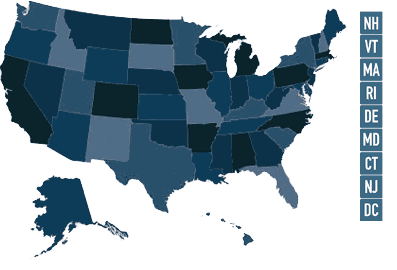
The table below shows confirmed exam states with passing scores, question counts, and time limits. Select your state in the map below for direct links to registration, the application, and official study material.
| State | Passing Score | Questions | Time Limit |
|---|---|---|---|
| Alabama | 70% | 50 | 1 hour |
| California | N/A | 150 | 2 hours |
| Florida | N/A | N/A | ~2 hours |
| Hawaii | 75% | N/A | N/A |
| Illinois | 70% | 75 | 90 minutes |
| Kansas | 90% (18/20) | 20 | N/A |
| Kentucky | Scaled score of 260 | N/A | N/A |
| Louisiana | N/A | N/A | N/A |
| Maine | N/A | N/A | N/A |
| Missouri | 70% | 75 | 2 hours |
| Montana | 70% | N/A | N/A |
| Nebraska | 80% | 40 | 45 minutes |
| Nevada | 75% | 100 | 2 hours |
| New Mexico | N/A | 23 | None (take at home) |
| New York | 70% | N/A | 150 minutes |
| North Dakota | N/A | 150 | N/A |
| Ohio | 80% | 55 | N/A |
| Oklahoma | N/A | N/A | N/A |
| Oregon | 86% (43/50) | 50 | N/A |
| Tennessee | 70% | 100 | 2 hours |
| Vermont | N/A | N/A | N/A |
| Washington | 100% | 30+ | N/A |
| Wisconsin | 84% | N/A | N/A |
| Arkansas | N/A | N/A | N/A |
| Georgia | N/A | N/A | N/A |
| Minnesota | N/A | N/A | N/A |
| North Carolina | N/A | N/A | N/A |
| Pennsylvania | N/A | N/A | N/A |
| South Carolina | N/A | N/A | N/A |
| Utah | N/A | N/A | N/A |
| Virginia | N/A | N/A | N/A |
| West Virginia | N/A | N/A | N/A |
Choose A State To View Exam Requirements
- Alabama
- Alaska
- Arizona
- Arkansas
- California
- Colorado
- Connecticut
- Delaware
- District of Columbia
- Florida
- Georgia
- Hawaii
- Idaho
- Illinois
- Indiana
- Iowa
- Kansas
- Kentucky
- Louisiana
- Maine
- Maryland
- Massachusetts
- Michigan
- Minnesota
- Mississippi
- Missouri
- Montana
- Nebraska
- Nevada
- New Hampshire
- New Jersey
- New Mexico
- New York
- North Carolina
- North Dakota
- Ohio
- Oklahoma
- Oregon
- Pennsylvania
- Rhode Island
- South Carolina
- South Dakota
- Tennessee
- Texas
- Utah
- Vermont
- Virginia
- Washington
- West Virginia
- Wisconsin
- Wyoming
Exam required:
- One-hour time limit
- 70 percent required to pass
- 50 questions divided into two categories:
- 34 practical PI knowledge
- 16 Alabama laws and rules
This test is administered by PSI Exams. See the candidate information bulletin (CIB) for more information.
Currently Alaska has no PI license requirements
Arizona does not require an exam as part of the PI licensing process
Exam required:
- The exam covers Arkansas laws and regulations governing private investigators
Contact the Arkansas State Police Regulatory Services Section for exam and application details.
Exam required:
- Two-hour time limit
- 150 questions divided among these categories:
- Information gathering – 22 percent
- Planning – 19 percent
- Reporting – 18 percent
- Analysis – 15 percent
- Ethics – 12 percent
- Trial preparation – 10 percent
- Surveillance – 4 percent
This test is administered by PSI Exams. The California Department of Consumer Affairs also offers a PI exam study guide.
Currently Colorado has no PI licensing requirements at the state level.
Connecticut does not require an exam as part of the PI licensing process
Delaware does not require an exam as part of the PI licensing process
District of Columbia – Washington DC
The District of Columbia does not require an exam as part of the PI licensing process
Anyone who performs services as a private investigator must obtain at least a Class C PI license. To be eligible for this you must pass a jurisprudence exam.
- No strict time limit, but you should be able to finish within two hours
- Questions evaluate your knowledge of:
- Florida’s private investigator handbook
- Florida statutes chapter 493
The exam is administered by the Florida Department of Agriculture and Consumer Services. You apply for this exam by filling out a PI license application.
Exam required:
- The exam covers Georgia statutes and rules pertaining to private investigations work
Apply for a PI license through the Georgia Secretary of State’s Private Detective Agencies division. Exam registration information is provided after your application is approved.
Exam required:
- Exams are held once a month on Oahu
- The passing score is 75 percent
- The content of the exam covers two main subjects:
- Private investigator skills and security investigations
- Laws, statutes, and rules related to being a PI in Hawaii
Exams are administered by the Hawaii Board of Detectives and Guards. You’ll receive a notice of exam approval once you’ve submitted a complete PI license application through the Hawaii DCCA MyPVL portal. For more information contact the board at [email protected].
Currently Idaho has no PI licensing requirements
Exam required:
- The time limit is 90 minutes
- You must score at least 70 to pass
- There are a total of 75 questions in total, divided among these topics:
- Federal and state law – 23 questions
- Gathering information – 16 questions
- Licensing and practice requirements – 12 questions
- Case management – 12 questions
- Analysis, presentation, and reporting – 12 questions
The exam is administered by Continental Testing Services (CTS). You can apply and register through CTS online. For more information, see the IDFPR private detective licensure page.
Indiana does not require an exam as part of the PI licensing process
Iowa does not require an exam as part of the PI licensing process
Exam required:
- 20 questions total – 5 true/false, 5 fill-in-the-blank, and 10 multiple choice
- You must answer at least 18 questions correct to pass
- The exam covers information from:
- Kansas Private Detective Licensing Act
- Kansas Administrative Regulations, chapter 16
- Criminal use of weapons, S.A.21-6302 (d)(3)
The exam is included in the state’s PI application for licensure.
Exam required:
- The exam covers these topics:
- KRS Chapter 329A – Private Investigations Act
- The Privacy Act of 1974
- Freedom of Information Act
- The Fair Credit Reporting Act
- Bill of Rights
- Kentucky Penal Code
- Private Investigators Board – Code of Ethics
- KRS Open Records Act
- Private investigator skills
A scaled score of 260 is considered passing. The exam is administered by Schroeder Measurement Technologies Inc. under contract with the Kentucky Board of Licensure for Private Investigators. To read all the relevant study material for this exam, see the Kentucky PI examination study guide.
Exam required:
- The exam covers the following subjects:
- Private investigator business
- General federal and state constitutional principles
- Relevant court decisions that could affect PI liability
- Search and seizure laws
- Invasion of privacy laws
- Weapons laws and use, including concealed weapons
The exam is managed and regulated by the Louisiana State Board of Private Investigator Examiners. You’ll receive information about registering for the exam once your PI license application is approved.
You’ll need to pass a written examination that is administered by the chief of the Maine State Police. Once your application for PI license has been approved you’ll receive information about how to register for this.
The exam covers subjects that relate to the situations you’ll encounter as a private investigator and applicable laws.
Maryland does not require an exam as part of the PI licensing process
Massachusetts does not require an exam as part of the PI licensing process
Michigan does not require an exam as part of the PI licensing process
Exam required:
- The exam covers applicable Minnesota laws and regulations governing private detectives
Contact the Minnesota Bureau of Criminal Apprehension for exam and application details.
Currently Mississippi has no PI licensing requirements
You must pass an exam to become a private investigator in Missouri unless you can demonstrate two years of relevant work experience.
- Two-hour time limit
- The passing score is at least 70 percent
- 75 questions in total:
- Rules and regulations pertaining to Missouri PIs – 55 questions
- PI general practice – 20 questions
The exam is administered by the Missouri Division of Professional Regulation. Contact the Division at dci.mo.gov for current exam registration information and to request an application. Once your application is approved the Division will send you an exam study guide and registration form.
Exam required:
- 70 percent is the minimum passing score
- The exam evaluates your understanding of:
- MCA Title 37, Chapters 1 and 60
- ARM 24, Chapter 182
Once your PI license application is approved the Montana Board of Private Security will provide you with examination details. The exam is a coordinated board exam.
Exam required:
- 45-minute time limit
- 40 questions total
- Must score at least 80 percent to pass
To register for this test you must first request a PI license application from the Nebraska Secretary of State. Once your PI license application is approved you’ll receive information on taking the exam, which is held the third Wednesday of each month at 10 a.m. at the Secretary of State’s office at 1201 N Street, Suite 120, Lincoln, Nebraska.
Exam required:
- Exams are offered quarterly, four times per year
- 100 questions total
- Two-hour time limit
- A passing score is at least 75 percent
- Test questions are on Nevada PI laws, legal procedures, and PI skills
Once your PI license application is approved Nevada’s Private Investigators’ Licensing Board will send you information about taking the exam.
New Hampshire does not require an exam as part of the PI licensing process
New Jersey does not require an exam as part of the PI licensing process
Jurisprudence exam required:
- No time limit; print the test and take it at home
- 23 questions total
- Exam topics cover:
- PI laws and regulations
- PI licensing
- PI procedures
You can find the jurisprudence exam and application for PI licensure through the New Mexico Regulation and Licensing Department’s Private Investigations Advisory Board page.
Exam required:
- 150-minute time limit
- A passing score is at least 70 percent
- Test questions cover these topics:
- PI license law
- Report writing
- Criminal and penal procedure law
- Investigative techniques
- Supervision and restrictions
- Interpreting written material
You register for this exam on a walk-in basis at any testing center throughout the state.
Exam required:
- The exam covers North Carolina statutes and rules governing private protective services
Apply through the North Carolina Department of Public Safety for licensing and exam details.
Exam required:
- 150 questions total
- The exam covers:
- PI skills and procedures
- North Dakota statutes regarding PIs
- North Dakota rules regarding PIs
Exams are arranged on an individual basis and taken in Bismarck. Contact the North Dakota Private Investigation and Security Board to schedule an exam. The board will send you an exam study guide if you send it a fee of $40.
Exam required:
- 55 questions in total
- 80 percent is the minimum passing score
- The exam covers rules and laws that pertain to private investigators
Once the company you’re going to work for has filed an employee registration application with the Ohio Department of Public Safety, the department will schedule you for an exam. All exams take place in Columbus.
If you do not have relevant private investigator experience or training you must pass an exam to become a licensed PI in Oklahoma.
- Exam is computer-based
- Available at 44 testing locations throughout Oklahoma
- The exam covers applicable laws and regulations that relate to being a PI in Oklahoma
You can schedule your exam at any participating career tech center throughout the state. You’ll receive information about registering for the exam and training once you complete an application for PI licensure.
PI Proficiency Exam required:
- Approximately 50 multiple choice questions
- Passing score is at least 43 correct answers
- The exam is now completed online through Workday, Oregon’s online learning management system
- Exam content covers PI licensing laws and legal procedures
Once your PI license application is processed, you’ll receive an email invitation with instructions on completing the exam online. See the Oregon DPSST’s PI exam information page for current details and Workday registration instructions.
Exam required at the state level. The Pennsylvania State Police administers PI licensing under the Private Detective Act.
- The exam covers applicable Pennsylvania laws and regulations governing private detectives
Contact the Pennsylvania State Police Licensing Division for application and exam details.
No exam required at the state level in Rhode Island; exam may be required at the county level
Exam required:
- The exam covers applicable South Carolina laws and regulations governing private investigators
Contact the South Carolina Law Enforcement Division (SLED) for exam and application information.
Currently South Dakota has no PI licensing requirements
Exam required:
- 120-minute time limit
- 70 percent is the minimum passing score
- 100 test questions:
- Tennessee rules and laws – 60 questions
- Practical knowledge – 40 questions
The exam is managed by the testing company PSI Exams. Once you’re ready you can sign up with PSI online. You do not need prior approval from the Tennessee Department of Commerce and Insurance.
Texas does not require an exam as part of the PI registration process
Exam required:
- The exam covers applicable Utah laws and regulations governing private investigators
Apply through the Utah Bureau of Criminal Identification. Exam details are provided with your application approval.
Exam required:
- Comprised of multiple-choice questions
- Topics covered are sourced from:
- Vermont statutes and administrative rules regarding private investigations
- Fair Credit Reporting Act
- Vermont public records
Once you have submitted a complete PI license application through Vermont’s online portal, the Office of Professional Regulation will provide you with instructions on taking the exam at the Vermont Board of Private Investigative and Security Services’ office in Montpelier. You must take this within 60 days of submitting your application for licensure.
Exam required:
- The exam covers applicable Virginia laws and regulations governing private investigators
Apply through the Virginia Department of Criminal Justice Services (DCJS). Exam registration information is provided through the DCJS licensing portal at lotus.dcjs.virginia.gov.
You must complete pre-assignment training from an approved provider before you can apply for your PI license. State law stipulates that you must pass an exam provided by your trainer related to the topics you have been trained in.
- The exam must have at least 30 multiple-choice questions
- You must score 100 percent on the exam
- If you answer any questions wrong, you must go back and review the question, then answer correctly
- The exam must cover all topics of training, including:
- Probable cause and evidence
- Legal powers and limitations
- Powers of arrest
- Expert witnesses
- Video and photography
West Exam required:
- The exam covers applicable Virginia laws and regulations governing private investigators
Apply through the West Virginia Secretary of State. Exam registration information is provided through the DCJS licensing portal at lotus.dcjs.virginia.gov.
Exam required:
- The purpose of the exam is to familiarize you with locating state laws and regulations
- The minimum passing score is 84 percent
- You can retake the exam as many times as you need, there is a fee each time
- The content of the exam is based on:
Once your application for a PI license is approved, the Department of Safety and Professional Services will clear you to test and provide you with exam access instructions. You can take the exam from any computer with an internet connection. Your exam results are valid for a year.
Currently, Wyoming has no PI licensing requirements
How to Prepare for the PI Licensing Exam
Every state that requires a PI exam also provides or points to official study material, and that’s your best starting point. Before spending anything on third-party prep courses, download your state’s official study guide or candidate information bulletin (CIB) from the testing agency. Most publish the exact topic breakdown and question distribution. Use it to direct your prep time toward what’s actually on the exam.
Most PI exams test two areas: state laws and regulations, and practical investigative procedures. On the law side, focus on your state’s licensing act, privacy statutes, rules of evidence, and any relevant sections of the penal code or administrative code. On the skills side, report writing, courtroom testimony, and surveillance procedures come up most consistently across states.
A few practical notes on the testing process: Tennessee lets you sign up directly with PSI Exams without waiting for prior approval from the state licensing agency. Check whether your state works the same way or requires application approval first. Oregon’s exam moved online through Workday, and you receive access via email after your application is processed. Wisconsin allows unlimited retakes for a fee; Washington requires you to review and correct any wrong answers before the exam counts. Knowing your state’s retake rules before you sit is worth the few minutes it takes to confirm.
Frequently Asked Questions
How many states require a PI licensing exam?
Based on current state regulations, approximately 30 states require passing a written exam as a condition of PI licensure. A small number of additional states make the exam optional, or allow it as an alternative to meeting experience requirements. States with no licensing requirement at all (Alaska, Colorado, Idaho, Mississippi, South Dakota, and Wyoming) have no exam requirement either.
What does the PI licensing exam cover?
Most state PI exams test your knowledge of the laws and regulations that govern private investigations in your state (the jurisprudence component). Many states also include a practical skills section covering report writing, surveillance procedures, courtroom testimony, and researching public records. Your state’s candidate information bulletin lists the exact topics and their weight on the exam.
What happens if I fail the PI exam?
Retake policies vary by state. Wisconsin allows unlimited retakes with a fee for each attempt. Some states impose a waiting period before you can test again. Others, like Washington, require you to review and correct wrong answers rather than simply retaking the full exam. Check your state licensing board’s website for its specific policy before you schedule.
Do I need to pass the exam before or after applying for my PI license?
It depends on the state. Tennessee lets you schedule directly with PSI Exams without waiting for license application approval. Most other exam states send you registration instructions only after your application has been approved. The state sections above identify this for each state; look for whether the section says you can register independently or whether approval comes first.
Where do I find official study materials for the PI exam?
Start with your state licensing board’s website and the testing agency’s candidate information bulletin. Most states that require an exam publish an official study guide or list the specific statutes that appear on the exam. The state sections above link directly to available study guides. Look for “study materials,” “CIB,” or “candidate information bulletin” links under your state.
Key Takeaways
- Approximately 30 states require a PI exam. About 30 states now require a written exam as a condition of licensure. A few others offer it as one possible route.
- Two exam types: jurisprudence and skills. Most states test state laws and regulations. Some also include practical topics like report writing and surveillance procedures.
- Passing scores and formats vary widely. From Nebraska’s 45-minute 40-question test to California and New York’s 150-question exams.
- Use official study materials first. Your state’s licensing board or testing agency publishes a candidate information bulletin listing exactly what the exam covers.
- Registration timing differs by state. Some states let you register directly with the testing provider, while others require license application approval before they’ll send you exam information.
Ready to start working toward your PI license? Find PI training programs in your state and see what credentials fit your path.