Most states require private investigators to be licensed, but requirements vary significantly. Typical minimums include being at least 21, passing a background check, and holding a surety bond. Many states require investigative experience, though the amount varies widely and may be reduced through education or training. A handful of states have no licensing requirement at all.
Private investigator license requirements vary more than most people expect. The age minimums differ, the experience thresholds differ, the agencies that issue licenses differ, and whether a license is required at all differs by state. What follows is a straightforward breakdown of the most common questions people have before they start the licensing process.


Do All States Require Private Investigators to Be Licensed?
No. A small number of states have no state-level licensing requirement for private investigators. As of the most recent review, those states are Idaho, Mississippi, and South Dakota. Wyoming and Alaska have no state license but do regulate PIs at the local level — Cheyenne, Wyoming, and both Anchorage and Fairbanks, Alaska each have their own licensing requirements.
In states without a licensing law, PIs still operate within the bounds of applicable business law and, in most cases, choose to join state professional associations that maintain their own codes of ethics and standards of practice. The absence of a license requirement doesn’t mean the absence of accountability — it means the accountability structure is different.
Most states and the District of Columbia require some form of licensure or registration for private investigators or investigative agencies. Requirements vary widely, so checking your specific state page is the only reliable way to know what you’re looking at. Licensing requirements, reciprocity rules, and issuing agencies change periodically, so applicants should verify current requirements directly with the appropriate state authority.
What Does It Take to Get Licensed?
In states that require a license, the baseline requirements tend to follow a recognizable pattern, even if the specifics shift from state to state.
Most states require applicants to meet all of the following:
- Be at least 21 years old (some states set the minimum at 18 or 25)
- Hold U.S. citizenship or legal residency
- Have a high school diploma or equivalent
- Pass a criminal background check, typically including fingerprinting
- Have no felony convictions, and in most states, no misdemeanor convictions involving fraud, moral turpitude, or violence
- Post a surety bond, with minimum amounts typically ranging from $5,000 to $25,000, depending on the state
Beyond those basics, experience requirements are where states diverge most sharply. Connecticut requires five years of full-time investigative experience or ten years as a police officer. Oregon accepts 1,500 hours, with up to 500 of those coming from college coursework. Some states, like Delaware, have no experience requirement at all for individual investigators — only for agency owners. A handful of states allow candidates with no experience to complete a state-approved training program and apply from there.
Education is rarely required outright, but it often reduces the number of experience hours you need. Many states give partial credit toward the experience requirement for an associate’s or bachelor’s degree in criminal justice or a related field.
Which State Agency Issues PI Licenses?
There’s no single answer — it depends on the state. The licensing authority varies by state, which is part of what makes this process confusing from the outside.
Common licensing authorities include:
- State police or highway patrol — New Hampshire, New Jersey, Maryland, and Maine all license PIs through the state police
- Department of Public Safety — Arizona licenses PIs through the Licensing Unit of the Arizona Department of Public Safety; Texas uses the Department of Public Safety’s Private Security Bureau
- Dedicated investigative boards — Tennessee has the Private Investigation and Polygraph Commission; North Dakota has the Private Investigations and Security Board; Louisiana uses the State Board of Private Investigator Examiners
- Department of Consumer Affairs or equivalent — California issues licenses through the Bureau of Security and Investigative Services within the Department of Consumer Affairs
- Secretary of State — Nebraska licenses PIs through the Secretary of State’s Licensing Division
Your state’s individual licensing page identifies the exact agency, its contact information, and the current application process.
What Does the Application Process Look Like?
Most states follow a similar sequence, even though the paperwork and fees differ. In general, here’s what the process looks like:
- Confirm eligibility — Verify that you meet the age, citizenship, background, and experience minimums for your state before spending time on paperwork.
- Complete required education or experience — Gather documentation of your qualifying work history or education credentials.
- Get fingerprinted — Most states require fingerprinting for a state and FBI background check. Some use electronic systems; others use ink cards.
- Obtain a surety bond — Work with a licensed surety bond company to secure the required bond amount.
- Submit the application with the required documentation and fees — typically including the application form, photos, proof of experience, bond documentation, and payment.
- Pass a state examination — Most licensed states require a written exam covering state law, regulations, and investigative practice. Passing scores typically range from 70% to 80%.
- Maintain your license through renewal and continuing education — license terms are usually 1 to 3 years. Some states require continuing education hours for renewal, while others do not.
Pennsylvania is a notable exception to the standard process — applicants there contact the Clerk of Courts in their county of residence and apply for licensure through the county court system rather than a state agency.
Are There Additional Requirements Beyond the Basics?
Yes. Several categories of additional requirements come up frequently across states.
Surety bonds: Nearly all states that license PIs require a commercial surety bond before issuing a license. These bonds protect clients against financial losses resulting from fraud or negligence by the investigator. Bond minimums typically start around $5,000 and can reach $25,000 or more for agency licenses.
Liability insurance: Some states also require general liability insurance, particularly for agency owners. Connecticut requires a $300,000 general liability policy in addition to the surety bond. Illinois requires $1 million in liability coverage. Coverage minimums are subject to change by state law and regulation.
Firearms permits: In states where armed private investigation work is permitted, investigators generally need a separate firearms permit, armed registration, or endorsement. This typically involves completing a state-approved firearms training course and, in some states, demonstrating proficiency on the range. The licensing agency for firearms is sometimes different from the one that issues the PI license itself.
Continuing education: Some states require licensed PIs to complete a set number of continuing education hours to renew their license — commonly 8 to 18 hours per renewal period, with some portion required in ethics — while others do not.
Can a PI License Be Used Across State Lines?
Not automatically. A PI license issued in one state is not valid in another state unless a reciprocity agreement exists between the two. When a PI crosses state lines to conduct an investigation, they’re generally expected to either hold a license in that state or operate under the authority of their home state license — and only if the investigation originated there.
Some states provide limited reciprocity, temporary authority, or exceptions for out-of-state investigators, though rules vary significantly. If you’re planning to work regularly across state lines, it’s worth checking directly with the licensing board in the states where you operate.
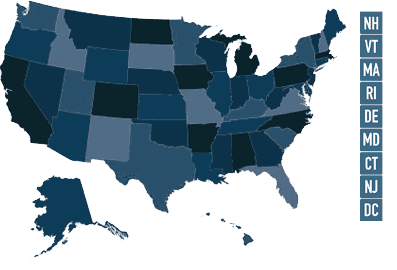
For a complete breakdown of licensing requirements in your state, use the map below or visit the state-by-state requirements page.
Choose A State To View Requirements
- Alabama
- Alaska
- Arizona
- Arkansas
- California
- Colorado
- Connecticut
- Delaware
- District of Columbia
- Florida
- Georgia
- Hawaii
- Idaho
- Illinois
- Indiana
- Iowa
- Kansas
- Kentucky
- Louisiana
- Maine
- Maryland
- Massachusetts
- Michigan
- Minnesota
- Mississippi
- Missouri
- Montana
- Nebraska
- Nevada
- New Hampshire
- New Jersey
- New Mexico
- New York
- North Carolina
- North Dakota
- Ohio
- Oklahoma
- Oregon
- Pennsylvania
- Rhode Island
- South Carolina
- South Dakota
- Tennessee
- Texas
- Utah
- Vermont
- Virginia
- Washington
- West Virginia
- Wisconsin
- Wyoming
Frequently Asked Questions
Do you need a license to be a private investigator?
In most states, yes. Most states and the District of Columbia require some form of licensure or registration for private investigators or investigative agencies. The exceptions are Idaho, Mississippi, and South Dakota, which have no state licensing requirement, and Alaska and Wyoming, where licensing is handled at the local level in certain cities. In states that require a license, operating without one may result in criminal or civil penalties depending on the jurisdiction.
What disqualifies you from getting a PI license?
A felony conviction disqualifies applicants in nearly every state that requires a license. Most states also disqualify applicants with misdemeanor convictions involving fraud, theft, moral turpitude, or violence — though the lookback periods and exact offense categories vary. Some states allow applicants to petition for a waiver if enough time has passed since the conviction. A dishonorable military discharge is also a disqualifying factor in many states.
How long does it take to get a private investigator license?
Processing time varies significantly by state, but most applicants should plan for 60 to 90 days from submission to approval. States that require a written exam may add time if testing is scheduled only periodically. Background checks — particularly FBI checks — can also extend the timeline. Having all documentation in order before you apply is the most reliable way to avoid delays.
Can I become a PI without law enforcement experience?
Yes, in many states. Some states — like Florida, Virginia, and Texas — have pathways for applicants without law enforcement backgrounds, typically through a combination of training hours, apprenticeship under a licensed PI, or a qualifying degree. A few states have no experience requirement at all for individual investigator licenses. The experience requirement matters most for agency owners, where most states set the bar higher.
What is a surety bond and why is it required?
A surety bond is a financial guarantee — issued by a licensed bonding company — that protects clients against losses resulting from negligence, fraud, or misconduct by the investigator. Most states require PIs to carry a bond as a condition of licensure. The required amount varies but commonly falls between $5,000 and $25,000. Obtaining a bond involves applying through a surety company and signing an indemnity agreement; the cost is typically a small annual premium based on the bond amount.
Key Takeaways
- Most states require a license — Most states and D.C. require some form of licensure or registration for PIs or investigative agencies. Idaho, Mississippi, and South Dakota do not.
- Requirements vary significantly — Age minimums, experience thresholds, exam requirements, and bond amounts all differ by state. Check your state’s page for specifics.
- Experience requirements vary widely — Many states require investigative experience, but the amount differs significantly and may be reduced through education or training.
- Surety bonds are nearly universal — Almost every licensed state requires a surety bond before it will issue a license. Bond minimums typically start at $5,000.
- Cross-state work requires careful review — Some states offer limited reciprocity or exceptions for out-of-state investigators, but rules vary significantly and change over time.
- Armed work requires a separate permit — In states that permit armed PI work, a separate firearms endorsement, registration, or permit is generally required.
Ready to take the next step? Find criminal justice programs in your state that can help you build the education and credentials you need to qualify for a PI license.