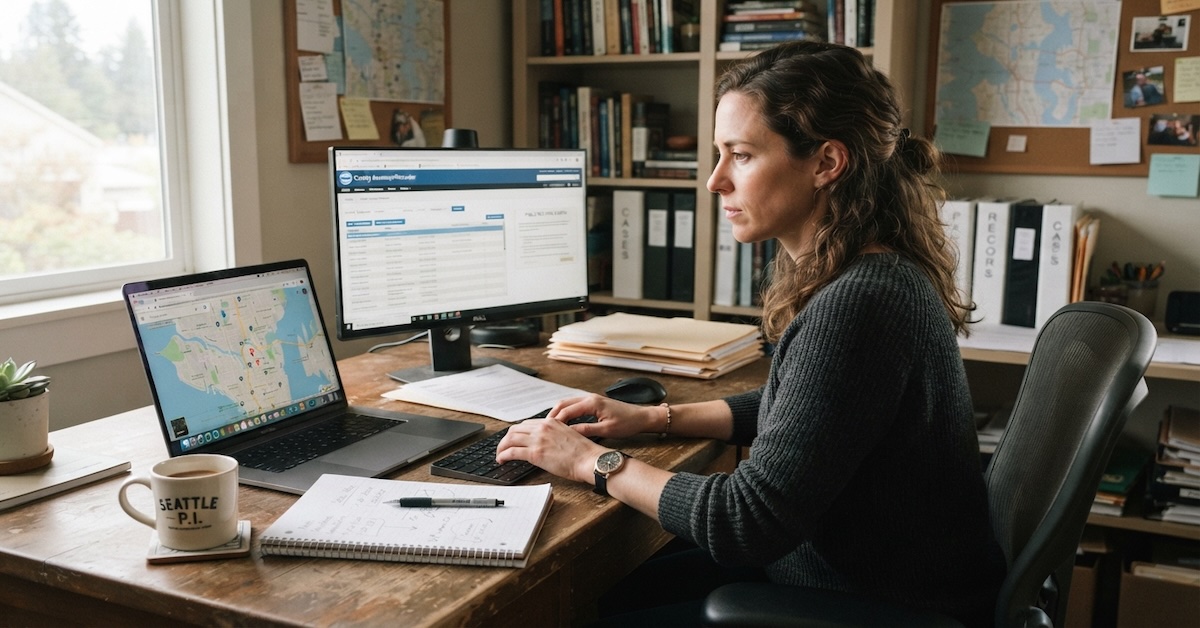


OSINT (open-source intelligence) means gathering and analyzing information from publicly accessible or lawfully obtained sources, from property records and court filings to social media posts and commercial investigative databases. Private investigators use it to run background checks, locate people, and document online activity, without hacking or unauthorized access.
Consider a hypothetical case: a property manager asks a PI to investigate information relevant to a tenant dispute. Business filings, public social media posts, and vehicle records may generate leads, but each finding must be verified and interpreted in its proper legal context. That’s OSINT, and it has become an increasingly important skill set in private investigation work.
What OSINT Actually Means for Private Investigators
OSINT, or open-source intelligence, is the collection and analysis of information available from publicly accessible or lawfully obtained sources. That includes government records, court dockets, corporate filings, news media, academic publications, social platforms, and commercial investigative databases available to approved subscribers, subject to credentialing, permissible-purpose restrictions, and applicable privacy laws.
For a PI, the distinction that matters most is legality. OSINT means no hacking, no wiretapping, and no logging into an account that isn’t yours. It’s a disciplined collection and analysis of what’s already out there, using the right subscriptions, search techniques, and patience to find it. Paid OSINT work may fall within a state’s definition of private investigation, depending on the nature of the assignment, the client, and applicable exemptions. Prospective providers should check the applicable laws and licensing authorities in each jurisdiction where they operate.
How Private Investigators Use OSINT
OSINT shows up in nearly every specialty a PI works, from insurance fraud to skip tracing. The table below breaks down the most common case types and the sources investigators typically draw from.
| Case Type | What It Looks Like | Typical Sources |
|---|---|---|
| Background checks and due diligence | Profiling a person or business before a hire, a deal, or litigation | Court records, business filings, social media |
| Insurance and fraud investigations | Comparing a claimed injury or income against actual behavior | Property and vehicle records, social media, court dockets |
| Skip tracing | Locating a missing person, debtor, or witness | Commercial data broker platforms, public records |
| Asset tracing | Uncovering hidden property, business ownership, or income | Property rolls, Uniform Commercial Code (UCC) liens, corporate filings |
| Corporate and IP investigations | Tracking counterfeit sellers or leaked company information | Marketplace monitoring, forums, public chatter |
Most investigators build a report by starting with a strong set of identifiers (name, date of birth, address history) from a commercial database, then pivoting to social platforms and the open web to fill in the picture. Important findings should be corroborated against independent sources whenever practicable before they are included in a client report.
The OSINT Toolkit: Records, Data Brokers, and Social Media
Public records form the backbone of most OSINT work: court dockets, recorded deeds and mortgages, corporate filings, UCC liens, professional licenses, and local permitting databases. On top of that, PI-focused data broker platforms like CLEAR, LexisNexis Accurint, and TLO give investigators a fast way to confirm identities and pull address history, phone and email links, and known associates. Database results may be incomplete, outdated, or based on inferred associations, and should be independently verified before being treated as fact.
Social media adds a different layer. Investigators use it for lifestyle verification in surveillance cases, mapping contacts and associates, and documenting harassment or reputation issues. Techniques include search operators, username correlation across platforms, and geolocating photos or videos using visible landmarks and, when available, metadata. Reverse image search tools such as Google Images, Yandex, and Bing Visual Search round out the kit for cases built around a single photo or video.
A smaller slice of the field goes further into technical OSINT: domain and DNS records, leaked credential checks, and basic scripting to structure large amounts of data. That work sits closer to digital forensics than traditional PI casework, and it’s exactly where computer forensics investigators pick up where general OSINT leaves off.
Where OSINT Can Cross Into Licensed PI Work
OSINT can feel like low-risk, low-touch work since nothing involves a stakeout or a knock on a door. But paid OSINT work may fall within a state’s definition of private investigation, depending on the nature of the assignment, the client, and applicable exemptions. A freelance “OSINT researcher” selling background reports without confirming that isn’t the case can end up practicing private investigation without a license. Prospective providers should check the laws and licensing authorities in each jurisdiction where they operate, starting with their state’s licensing requirements. The guide to private investigator laws covers how states generally define and regulate the profession.
Legal exposure doesn’t stop at licensing. Investigators should not use another person’s credentials, bypass access controls, or obtain information in violation of applicable law or contractual restrictions. Automated collection can also violate a platform’s terms, trigger account restrictions, or create contractual and legal risk, depending on what was accessed, whether technical barriers were bypassed, and the applicable jurisdiction. For findings to be useful in court, investigators should preserve the original URL, collection date and time, available metadata, and an unaltered copy of the material, along with a clear record of any cropping or redaction. A screenshot without supporting documentation is an easy target for opposing counsel.
Learning OSINT: Courses, Certifications, and Degree Programs
Overall, investigative work offers a solid entry point for people building these skills. The Bureau of Labor Statistics reports a median annual wage of $52,370 for private detectives and investigators as of May 2024 and projects 6% employment growth from 2024 to 2034.
OSINT training is offered through a range of private providers, but course titles, levels, and recognition vary. Investigators may also consider established credentials relevant to their work, such as ASIS International’s Professional Certified Investigator (PCI) credential or a relevant digital-forensics credential from the Global Information Assurance Certification (GIAC). The PCI is an experienced-practitioner credential rather than an introductory OSINT qualification.
Some criminal justice, cybercrime, digital forensics, and intelligence studies programs include coursework relevant to OSINT, such as social media investigation, geolocation, data analysis, and privacy law, even when the curriculum doesn’t use the word “OSINT” directly. If you’re comparing options, PrivateInvestigatorEDU’s list of online degree and certificate programs is a good starting point for finding one with a digital investigation or cybersecurity component.
Frequently Asked Questions
What’s the difference between OSINT and illegal surveillance?
OSINT relies only on information that’s already public or accessible through a legitimate commercial investigative database for which the user is authorized and has an appropriate permissible purpose. It never involves hacking into accounts, wiretapping, or accessing anything behind a login you don’t have permission to use. If a technique requires bypassing security or misrepresenting your identity to gain access, it’s no longer OSINT and can expose you to both platform bans and legal liability.
Can I work as an OSINT researcher without a PI license?
It depends on your state and what you’re selling. Independent research and journalism are often treated differently from commercial investigative services, but applicable definitions and exemptions vary by state. Paid OSINT work may fall within a state’s definition of private investigation, depending on the nature of the assignment, the client, and applicable exemptions. Check the law and licensing authority in your state before advertising OSINT services commercially.
What OSINT tools should I learn first?
Most working investigators start with a commercial data-broker platform to build a reliable set of identifiers: current address, phone numbers, relatives, and associates. From there, they move into social media search techniques and open-web tools to fill in the picture, then add reverse image search and geolocation for cases built around photos or video.
Do I need a college degree to do OSINT work?
No single degree is required, and some investigators build these skills entirely through vendor certifications and fieldwork. That said, some degree programs in criminal justice, cybercrime, digital forensics, or intelligence studies include OSINT-relevant coursework. In some jurisdictions, specified education may satisfy part of a PI licensing experience requirement; eligibility rules vary by state.
Can OSINT findings hold up in court?
OSINT material can be used in court, but admissibility depends on the applicable rules of evidence and whether the material can be authenticated. Investigators should preserve the source, URL, collection date and time, available metadata, and an unaltered copy of the material, while documenting how it was collected and handled.
Key Takeaways
- OSINT relies on public or lawfully obtained information — never hacking, wiretapping, or unauthorized account access.
- Licensing can still apply — paid OSINT work may fall within a state’s definition of private investigation, depending on the assignment and jurisdiction.
- Skills come from multiple paths — OSINT training, established investigative credentials, and relevant degree programs all build competency.
Building a career around investigative research? Explore private investigator schools and degree programs that fit your goals.
May 2024 US Bureau of Labor Statistics salary and job market figures for Private Detectives and Investigators reflect state and national data, not school-specific information. Conditions in your area may vary. Data accessed July 2026.