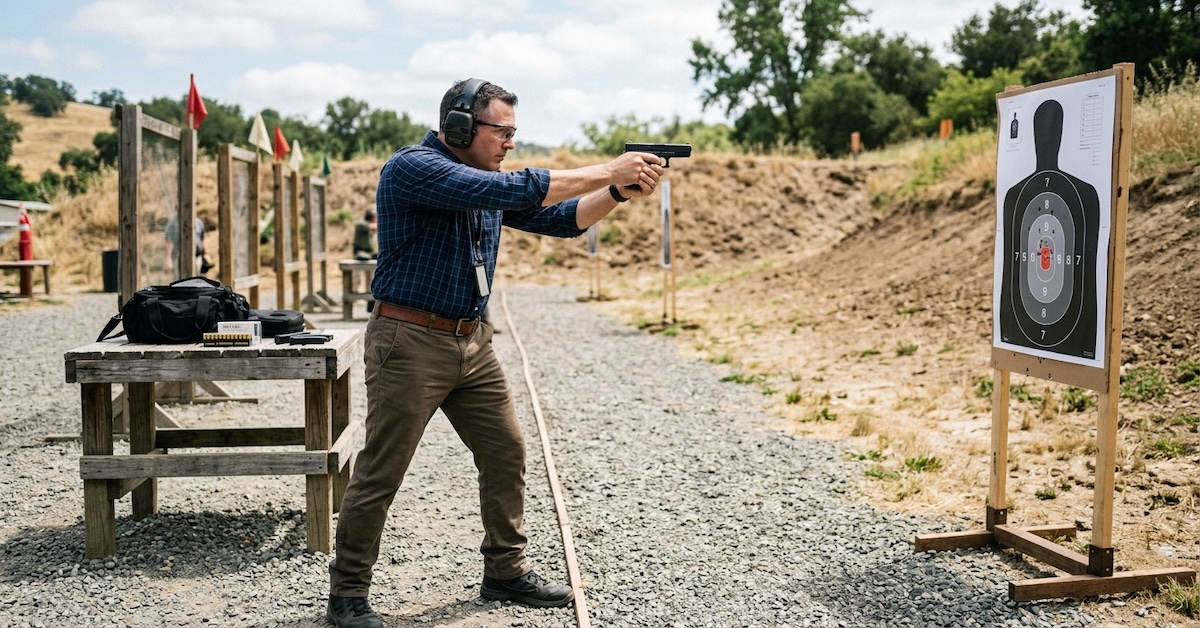
A PI license alone doesn’t grant special firearms rights. Whether a private investigator can carry a gun depends on state law. Many states require a separate armed PI endorsement or additional firearms permit on top of the standard license, with mandatory training and range qualification. A few states add nothing beyond ordinary civilian carry law. Requirements differ significantly by state.
Most working PIs never draw a weapon. The job runs on surveillance logs, database searches, and careful documentation, not parking garage shootouts. But whether private investigators can carry guns is a legitimate question for anyone deciding which state to work in, which specialty to pursue, or whether the armed endorsement their state offers is worth pursuing. The answer is more layered than most people expect.
A PI license is a professional credential. It establishes that you’re qualified to conduct investigations for hire. It doesn’t change your legal status regarding firearms, and it doesn’t substitute for any permits or training your state requires for carrying a weapon on the job. Here’s how the actual rules work, state by state.
This article provides general educational information about PI firearms licensing and is not legal advice. Always verify current requirements with your state licensing board and consult a licensed attorney before making decisions about carrying a firearm in a professional capacity.


Your PI License and Your Carry Rights Are Two Separate Things
Getting licensed as a private investigator and getting authorized to carry a firearm on the job are two separate regulatory processes in virtually every state. A PI license establishes investigative credentials. It doesn’t change your underlying legal status regarding firearms.
In most states, the baseline is the same civilian gun law that applies to everyone. You still need to satisfy background check requirements, prohibited-person rules, and whatever your state requires for concealed or open carry. A PI license doesn’t exempt you from any of that. What varies is whether your state adds a layer specifically for armed investigators.
For the full picture of how PI licensing is structured across the country, the private investigations laws guide covers all 50 states.
How States Regulate Armed PIs: Three Models
State laws fall into three broad patterns for armed PI carry. Understanding which model applies where you want to work is the first step in knowing what you’d actually need to do to carry legally on the job.
- Dedicated armed PI license or endorsement: States like Washington and Virginia define “armed private investigator” as a specific credential that must be added to the standard PI license. You need to meet separate requirements, complete firearms-specific training, and hold the endorsement to carry while working.
- PI license plus standard handgun permit: States like Maryland and Florida don’t create a separate armed PI category in the same way, but they require armed investigators to hold a valid handgun permit and document their qualifications with specific weapons. The PI license doesn’t substitute for those requirements.
- General civilian carry law only: States like Texas add no PI-specific firearms requirements at all. If you can legally carry under state law, you can generally carry while working. But the PI license adds no carry authority beyond what the civilian framework already allows.
The table below shows how six states handle armed PI carry, representing well-documented examples across all three models. Firearms laws and licensing requirements change. Requirements should be verified with the relevant state licensing authority before relying on this information—requirements summarized as of June 2026.
| State | Armed PI Credential? | Separate Carry Permit Required? | Firearms Training Required? | Key On-Duty Restrictions |
|---|---|---|---|---|
| Washington | An armed PI license or endorsement is required under RCW 18.165.040 | A concealed pistol license plus a CJTC firearms certificate are both required | Certificate from the Criminal Justice Training Commission; pre-assignment training required; proficiency standards by firearm type | On-duty only; employer must own and register firearms per RCW 18.165.060; no carry or display while soliciting clients |
| Virginia | Firearms endorsement on PI registration required per 6 VAC 20-171-365; renewed every 12 months | Concealed handgun permit plus written employer authorization required under Va. Code § 18.2-308 | 60-hour PI entry training plus separate firearms training for the endorsement; requalify annually | PI registration alone does not authorize carry; a firearms endorsement and employer permission are both required |
| Maryland | No separate armed PI credential; agency must document each armed detective per COMAR 29.04.08.13 | Valid handgun permit required for every armed detective | Must qualify with each specific weapon; scores and weapon data submitted to the Licensing Division Handgun Permit Section before carrying | May carry only weapons on file with qualifying scores; personnel file must contain a copy of the handgun permit for each armed detective |
| Florida | Separate Class “G” Statewide Firearms License required in addition to the Class “C” PI license per § 493.6201(7), Florida Statutes | Class G serves as the carry authorization for PI and security work while on duty | 28 hours initial training (at least 8 hours in-person range); 4 hours annual requalification; all training by a Class “K” licensed instructor | Class G remains valid only while employed as a licensed PI; strict rules on weapon type, caliber, and number of firearms carried |
| Texas | No PI-specific armed license; special carry authority applies to commissioned security officers and personal protection officers, not PIs | PIs carry under the general Texas handgun law (permitless or licensed carry per Penal Code Ch. 46) | No PI-specific training required by the Private Security Act | May not openly carry while executing a capias or arrest warrant per 37 T January 10.10 (eff. Jan. 10, 2022) |
| GeorgiaThe | The board issues firearms permits to licensees under O.C.G.A. § 43-38-10, which covers the unified private detective and security licensing framework. | Board-issued permit required; general state carry laws also apply | Annual qualification with each weapon carried; range scores retained on file; discharge reports required within 10 business days per GAC Rule 509-4-.05 | Carry limited to providing services or traveling directly to and from work under GAC Rule 509-4-.01; prohibited while soliciting clients |
Always verify current rules with your state licensing board before making any decisions about carrying on the job.
States With Armed PI Endorsements or Licenses
A handful of states define “armed private investigator” as a formal credential obtained separately from the standard PI license. These states treat armed and unarmed investigative work as distinct licensing categories, with separate requirements and renewal cycles for each.
Washington
Washington’s Revised Code Sections 18.165.040 and 18.165.060 lay out a specific checklist. To qualify for an armed PI license, you must already hold a standard PI license, be at least 21 years old, hold a current firearms certificate from the Washington Criminal Justice Training Commission (CJTC), and carry a valid concealed pistol license. The armed PI credential can be issued as an endorsement on the existing PI license.
Under RCW 18.165.060(2), all firearms carried by armed PIs in the performance of their duties must be owned by the employer and, where state law requires, registered with the appropriate agency. Carrying a firearm while performing PI duties without a valid armed PI license constitutes gross misdemeanor unprofessional conduct. One provision that rarely receives attention is RCW 18.165.165, which prohibits any licensee, employee, or agent of a licensee from displaying a firearm while soliciting clients.
Virginia
Virginia uses a firearms endorsement system administered by the Department of Criminal Justice Services (DCJS). The agency is explicit in its guidance: being registered as a PI does not authorize carrying a concealed weapon. Anyone who will carry or have access to a firearm while on duty must complete the requirements for a Firearms Endorsement under 6 VAC 20-171-365 of the Virginia Administrative Code.
That endorsement requires separate firearms training and must be renewed every 12 months, independent of the PI registration renewal cycle. For concealed carry, investigators also need a valid concealed handgun permit and written authorization from their employer under Va. Code § 18.2-308. Three separate requirements, each with its own paperwork and renewal schedule.
Florida
Florida routes armed investigative work through its Class “G” Statewide Firearms License, which sits outside the standard PI licensing structure. Under Florida Statute § 493.6201(7), a Class “C” licensee (private investigator) who bears a firearm must also hold a Class “G” license. The licensing authority is the Florida Department of Agriculture and Consumer Services (FDACS), Division of Licensing, not the standard business and professional regulation pathway.
The Class G credential requires 28 hours of initial training, with at least 8 hours as in-person range training, all administered by a Class “K” licensed firearms instructor. Once licensed, Class G holders must complete 4 hours of annual requalification training with a Class “K” instructor to keep the credential active. Missing the first-year annual requalification automatically suspends the Class G license. The PI license and the Class G license are separate credentials with separate application processes and renewal requirements.
States Where PIs Carry Under General Firearms Law
Not every state layers special requirements on PI firearms carry. In some states, PI status neither helps nor restricts the right to carry. You have the same rights as any other citizen under that state’s firearms laws, and the PI license adds nothing to that.
Texas
The Texas Department of Public Safety is clear on this: the Private Security Act authorizes commissioned security officers and personal protection officers to carry while on duty. Private investigators are not in that category. Individual PI licensees may carry while working under the standard Texas Penal Code Chapter 46 framework, whether that means permitless carry or a licensed carry permit. The PI license adds nothing to the civilian carry framework.
Texas does add one investigative-specific restriction worth noting. Under 37 TAC § January 10, effective January 10, 2022, private investigators are prohibited from openly carrying a handgun when executing a capias or arrest warrant, even when open carry would otherwise be permitted under state law. Violation of this rule carries the risk of licensing action.
The Broader Pattern
The Texas model reflects what you’ll find in several states: no armed PI category, no endorsement process, and whatever the civilian carry framework allows. In practice, employer policy and professional liability insurance often do more to address these issues than the statute does, because agencies understand that an armed employee without documented training and written protocols creates significant liability exposure regardless of what the law technically requires.
Firearms Training and Qualification Requirements
In states that create a formal armed PI credential, training requirements are considerably more specific than most people expect going in. A general firearms safety course rarely satisfies them.
Washington requires pre-assignment training before an armed PI can begin working, with proficiency standards set by the Criminal Justice Training Commission for each specific firearm type. Investigators may carry only the weapons for which they’ve demonstrated certified proficiency. Virginia’s firearms endorsement requires separate training from the 60-hour PI entry training and must be renewed every 12 months. Maryland’s COMAR 29.04.08.13 requires investigators to qualify with each weapon they plan to carry and to submit the weapon type, serial number, and qualifying scores to the Licensing Division Handgun Permit Section before carrying that firearm. Florida requires 28 hours of initial training, with no more than 20 hours permitted online and at least 8 hours of in-person range training, plus 4 hours of annual requalification, all conducted by a Class “K” instructor. Georgia mandates annual qualification with the specific weapon carried, with scores retained on file and any discharge reported to the licensing board within 10 business days.
The practical implication is that in states with formal armed PI requirements, being generally comfortable with firearms isn’t sufficient. You need a documented qualification with the specific weapon you’ll carry on duty, and in most cases, you’ll requalify periodically to keep the endorsement active. This is a professional accountability framework, not a training checkbox.
On-Duty Carry Restrictions: Tighter Than Most People Realize
Even in states where armed PI carry is well established, the authority to carry is tightly constrained. Georgia’s Rule 509-4-.01 illustrates this clearly: no person licensed or registered by the Georgia Board of Private Detective and Security Agencies to provide services may carry a firearm except while providing actual services on behalf of their employer or while traveling directly to and from work. No stopover along the way is permitted. The weapon lives at work.
Washington establishes a parallel framework under RCW 18.165.060. Carry authority is tied to the performance of investigative duties. Off-duty, the endorsement creates no special right beyond what ordinary civilian carry law allows.
The restrictions around client solicitation are also worth understanding. Both Washington and Georgia explicitly prohibit displaying a firearm or having an armed employee present while soliciting new clients. This isn’t a technicality. It reflects regulators’ view that an armed investigator in the room during a sales conversation exerts an implicit pressure that licensing frameworks are not designed to authorize.
Liability and Risk for Armed Investigators
In Washington, carrying a firearm while performing PI duties without a valid armed PI license is gross misdemeanor unprofessional conduct. In Maryland and Georgia, agencies that fail to maintain required documentation or file required discharge reports may face licensing board action.
Working armed outside the bounds of applicable licensing rules creates legal exposure on multiple levels. On the regulatory side, states with armed PI credentials treat unauthorized armed work as serious professional misconduct. Depending on the state, a first offense can put both the PI license and the firearms endorsement at risk.
On the civil side, any use of force that can’t be clearly justified under state law exposes both the investigator and the employing agency to tort claims. Requirements for employer-owned and registered weapons, such as those under Washington’s RCW 18.165.060, and mandatory discharge reporting requirements, such as Georgia’s Rule 509-4-.05, exist in part because regulators understand that documentation is the only workable way to manage that exposure at scale.
Insurance and bonding coverage add another dimension to the risk picture. Washington requires agencies to maintain surety bonds or liability coverage under RCW 18.165.100, and policy language may affect coverage depending on whether the investigator was armed without proper authorization or was carrying outside their licensing conditions. Being armed without the right paperwork can leave both the investigator and the agency in a difficult position if an incident occurs. Review your policy carefully and consult an attorney familiar with your state’s private security statutes before beginning armed investigative work.
Building the Legal Foundation Through Education
Navigating armed PI licensing correctly requires understanding how state law, professional licensing, and carry authority interact. Most people don’t arrive at that understanding intuitively, and mistakes in this area carry real professional and legal consequences.
A criminal justice degree or a PI-specific training program builds the statutory fluency that makes those distinctions legible before you’re in the field. Programs in criminal justice, law enforcement studies, and legal studies provide a grounding in state law, evidentiary standards, and professional conduct frameworks that translate directly into sound decisions about investigative authority and its limits.
Several schools also offer certificate programs and continuing education tracks that include firearms training components designed specifically for private security and investigative professionals. In states like Washington and Virginia, which have formal pre-assignment training requirements, these programs can satisfy those requirements while building the documented credentials that larger investigative agencies look for when hiring for armed investigator positions.
For prospective PIs, reviewing available programs before committing to a licensing state can help align your education with the specific credential requirements you’ll face there. The schools-by-state directory lets you explore options by location.
Frequently Asked Questions
Can a private investigator carry a gun?
In many states, yes, but it depends on state law and whether the PI holds any additional credentials the state requires. In states like Washington and Virginia, a PI must obtain a separate firearms endorsement and complete specific training before carrying on the job. In states like Texas, a PI may carry under the same civilian carry rules that apply to everyone else, with no PI-specific authorization required. A standard PI license alone generally doesn’t grant special firearms rights in the states reviewed here.
Does a PI license allow concealed carry?
No. A PI license is an investigative credential, not a carry permit. In states that require a concealed carry permit, PIs still need one, just like any other citizen. Virginia’s DCJS states this directly: PI registration does not authorize carrying a concealed weapon. The firearms endorsement under 6 VAC 20-171-365 and a separate concealed handgun permit are both required. In Florida, the Class G license provides the carry authorization for on-duty work, but a standard PI license alone contributes nothing to concealed carry authority.
Can I become a private investigator if I don’t want to carry a gun?
Yes. The vast majority of investigative work is unarmed. Surveillance, background investigations, insurance fraud work, digital forensics, and most corporate investigation roles don’t involve carrying a weapon. Unarmed PIs work in every state, and states like Washington maintain a separate armed PI credential precisely because they treat unarmed and armed investigative work as distinct licensing categories. Not carrying is a common and legitimate professional choice.
What training is required to carry a firearm as an armed private investigator?
Requirements vary by state, but in states with formal armed PI frameworks, training is specific and ongoing. Washington requires a CJTC firearms certificate and documented proficiency for each weapon type, with pre-assignment training before working with any weapon. Virginia requires separate firearms training for the endorsement under 6 VAC 20-171-365, with annual renewal. Maryland requires documented qualification with each firearm, with qualifying scores submitted to the state per COMAR 29.04.08.13. Florida requires 28 hours of initial training (at least 8 hours in-person range) plus 4 hours of annual requalification with a Class “K” instructor. Georgia requires annual qualification per GAC Rule 509-4-.01. In states like Texas that rely on civilian carry law, no PI-specific training is required by statute. However, employer policy and insurance requirements often fill that gap.
What happens if a PI carries a gun without the proper license or endorsement?
The consequences vary by state but can be severe. In Washington, carrying a firearm while performing PI duties without a valid armed PI license is a gross misdemeanor under RCW 18.165, which means criminal exposure and potential loss of the PI license. In Maryland, failure to maintain required documentation on armed employees creates regulatory risk for the agency under COMAR 29.04.08.13. In Georgia, agencies that fail to file required discharge reports under Rule 509-4-.05 face licensing board action under O.C.G.A. § 43-38-11. Operating armed without proper authorization may also affect the agency’s insurance coverage for any incident involving that employee, depending on policy language.
Do former law enforcement officers get exemptions for carrying as a PI?
The federal Law Enforcement Officers Safety Act (LEOSA), codified at 18 U.S.C. §§ 926B-926C, authorizes qualified active and retired law enforcement officers to carry concealed across most jurisdictions under federal law, notwithstanding state or local restrictions. Retired officers must carry the required photographic identification and meet an annual firearms qualification standard. However, LEOSA does not override federal facility restrictions, federal gun-free school zone provisions, or restrictions on private property. More importantly for PIs: LEOSA does not satisfy state-level armed PI endorsement requirements in states such as Washington and Virginia. The two frameworks are independent of each other. A retired officer entering PI work in those states still needs to obtain the applicable armed PI credential if they want to carry while performing investigative duties.
Key Takeaways
- A PI license is not a carry permit — Firearms authorization is a separate regulatory track from PI licensing in the states reviewed here. Holding a PI license generally grants no special right to carry a firearm on the job.
- Three models govern armed PI work — States use dedicated armed PI endorsements (Washington, Virginia), PI-plus-handgun-permit frameworks (Maryland, Florida), or general civilian carry law with no PI-specific overlay (Texas).
- Training requirements are specific and recurring — States with formal armed PI credentials require documented qualification with specific weapons, submitted to the licensing agency, with periodic renewal. Annual requalification is the standard, not the exception.
- On-duty carry authority is narrowly bounded — Armed PI authorization typically covers active duty and direct travel to and from work. It does not extend to off-duty carry, and carrying or displaying a weapon while soliciting clients is prohibited in multiple states.
- Operating without proper credentials creates serious exposure — Unauthorized armed PI work can result in criminal charges, licensing action, and insurance complications, depending on the state and policy language.
- Education builds the foundation — Criminal justice and PI training programs develop the legal knowledge and documented credentials that matter most in states with formal armed PI licensing requirements.
Exploring PI education options? Find criminal justice programs and PI training programs in your state, and build the credentials that armed PI licensing requires.