
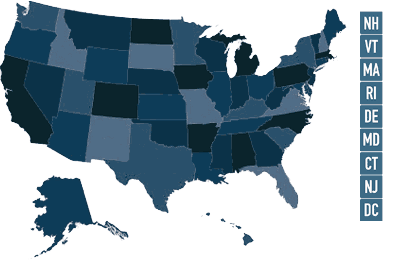
PI licensing requirements vary significantly by state. Most states require verified investigative or law enforcement experience (typically 2–4 years), a criminal background check, a surety bond, and a written exam covering state statutes and investigative practices. A handful of states have no statewide licensing requirement. Select your state on the map below for exact requirements.
Private investigator licensing is governed at the state level — there’s no federal standard, no national exam, and no universal experience requirement. What qualifies you in California may not satisfy Colorado’s board, and a state like Idaho doesn’t require a license at all. This page breaks down how the system works in practice: the typical licensing pathway, what most exams cover, how renewal works, and what reciprocity means for PIs working across state lines.
Choose A State To View Requirements
- Alabama
- Alaska
- Arizona
- Arkansas
- California
- Colorado
- Connecticut
- Delaware
- District of Columbia
- Florida
- Georgia
- Hawaii
- Idaho
- Illinois
- Indiana
- Iowa
- Kansas
- Kentucky
- Louisiana
- Maine
- Maryland
- Massachusetts
- Michigan
- Minnesota
- Mississippi
- Missouri
- Montana
- Nebraska
- Nevada
- New Hampshire
- New Jersey
- New Mexico
- New York
- North Carolina
- North Dakota
- Ohio
- Oklahoma
- Oregon
- Pennsylvania
- Rhode Island
- South Carolina
- South Dakota
- Tennessee
- Texas
- Utah
- Vermont
- Virginia
- Washington
- West Virginia
- Wisconsin
- Wyoming


The Typical PI Licensing Pathway
The specifics vary by state, but the broad sequence of steps is consistent across most licensed jurisdictions. Understanding the general shape of the process helps you plan — especially for the experience requirement, which has the longest lead time for most applicants.
1. Confirm minimum eligibility. Almost every state sets a minimum age (usually 18 or 21, though Connecticut and Maryland require 25) and requires lawful presence or work authorization in the United States. Many states restrict licensure for applicants with felony convictions or certain misdemeanor histories, though waiver and rehabilitation provisions vary significantly by state. Check these thresholds first — they’re non-negotiable.
2. Accumulate qualifying experience. This is the step that takes the longest. Most states require 2–4 years of documented investigative or law enforcement experience. Working as an employee of a licensed PI agency is the most common route — conducting surveillance, documenting evidence, locating missing persons, or supporting government investigative work. Former law enforcement officers and military investigators typically count their service toward the requirement. Security guard work generally does not qualify.
3. Get fingerprinted and run the background check. Most states require fingerprinting for both a state-level and an FBI criminal history check. In some states, this happens before you submit your application; in others, it’s part of the application package. Allow several weeks for background check processing.
4. Pass the licensing exam. Most states that require a license require a written exam before issuing it. Exams are typically administered by the licensing board or a contracted testing vendor, and scheduling can add weeks to the timeline. See below for what these exams typically cover.
5. Obtain a surety bond and submit your application. A surety bond — typically between $5,000 and $100,000, depending on the state — protects clients in the event of misconduct. Some states also require general liability insurance. Application fees vary widely, from under $100 to several hundred dollars for initial licensure.
6. Receive your license and begin work. Processing times after a complete application typically run 60 to 90 days. Having all documentation assembled before you apply is the most reliable way to avoid delays.
Working Without a License
In many states, you don’t need your own license to work in the field. A significant number of jurisdictions — including Georgia, Delaware, Indiana, Texas, and Washington — allow individuals to work as registered employees of a licensed PI agency without holding an independent license. The agency’s license covers its employees. This is the standard entry point for most people new to the profession: you get hired, register as an employee, and start accumulating the experience hours you’ll eventually need to apply for your own license or open your own agency.
The distinction matters. In these states, the licensing requirement falls on the agency, not the individual investigator. If you’re starting, you don’t need to meet the full experience threshold to work legally — you just need to find a licensed agency willing to bring you on.
How Education Factors In
Most states don’t require a degree, but education can work in your favor. Several states allow criminal justice coursework or a degree to substitute for a portion of the required work experience. California credits an associate’s degree with 500 hours toward its experience requirement and a bachelor’s with 1,000 hours. North Carolina credits an associate’s degree with 400 hours, a bachelor’s degree with 800 hours, and a graduate degree with 1,200 hours toward its 3,000-hour minimum. Indiana accepts a four-year criminal justice degree in place of its entire 4,000-hour experience requirement.
Even where education isn’t formally credited, firms hiring junior investigators tend to prefer candidates with criminal justice, law enforcement, or legal studies backgrounds. For a breakdown of PI training and degree programs by credential level, including which formats are accepted for state licensing purposes, see our program comparison guide.
What PI Licensing Exams Cover
Most states administer a multiple-choice written exam as part of the licensing process. Exams typically run 50 to 150 questions, with passing scores ranging from 70% to 80%, and most give candidates 2 to 3 hours to complete them.
Content varies, but most PI licensing exams draw from these areas:
- State statutes governing private investigations — the specific laws regulating PI conduct, licensing requirements, and prohibited activities in your state
- Surveillance law and privacy — what investigators can and cannot legally do when observing, recording, or following subjects
- Evidence handling and documentation — proper chain of custody, report writing standards, and admissibility considerations
- Interview and interrogation law — what investigators are and aren’t permitted to do when questioning individuals
- Business practices and ethics — contracts, client confidentiality, conflicts of interest
- Use of force — particularly relevant for applicants seeking armed status
Most states publish a study guide or list the specific statutes the exam draws from. Reading the relevant chapter of your state’s administrative code — not just summaries of it — is the most reliable exam preparation. Some states use third-party testing vendors who provide candidate handbooks with sample questions. If you fail, most states require a waiting period before retesting, typically 5 to 30 days.
License Renewal and Continuing Education
PI licenses are not permanent. Most states require renewal every 1 or 2 years, and many also require continuing education (CE) as a condition of renewal. Requirements typically run 8 to 32 hours per renewal cycle. Virginia requires 8 hours per two-year cycle; Oregon requires 32 hours over the same period, with at least 2 in ethics. Some states break it down by topic — Alabama requires 16 hours per cycle, with 2 specifically in ethics; Oklahoma requires 16 hours annually.
Acceptable CE sources generally include professional association seminars and conferences, approved online courses, college coursework in relevant fields, and, in some states, publishing articles or presenting at industry events. Most states publish a list of approved providers or require pre-approval for courses not on a standardized list.
Armed investigators face additional renewal requirements in states that license firearm carry separately — typically annual or biennial range requalification in addition to the standard CE hours.
Reciprocity and Multi-State Licensing
Reciprocity — where one state honors a license issued by another — is limited in the PI field. Unlike some licensed professions, there’s no broad national framework. Most states require out-of-state investigators to obtain a local license if they intend to work within that state regularly.
A few states have formal bilateral agreements that allow a licensed PI from one state to qualify for a license in another based on their existing credential rather than starting from scratch. These agreements are specific, limited to named states, and can change — always verify current reciprocity status directly with the relevant state licensing board before relying on it.
For PIs who regularly work across state lines — insurance investigations, corporate due diligence, cases that cross borders — the practical approach is to hold licenses in each state where you work regularly. Some states have provisions for temporary licensure for out-of-state investigators working on a specific case; the requirements for these provisions are detailed in each state’s licensing statutes.
States Without a Licensing Requirement
Several states have historically not maintained statewide PI licensing systems — including Idaho, Mississippi, South Dakota, and Wyoming. Alaska has no statewide license, but Anchorage and Fairbanks have each required city-issued licenses. State regulatory frameworks change, so always verify current requirements directly before operating in any state.
The absence of a licensing requirement doesn’t create additional legal permissions. Investigators in unlicensed states are still bound by state and federal laws governing electronic surveillance, wiretapping, trespass, and privacy. The rules of the work still apply — there’s just no board to revoke your license if you cross a line.
Private Investigator Salaries by State
Pay varies considerably by location, specialization, and employer type. According to the Bureau of Labor Statistics, private investigators earned a national median annual wage of $52,370 as of May 2024, with the top 10% earning $98,770 or more. The table below shows how a range of states compares. For metro-level breakdowns and full state-by-state data, see the private investigator salary page.
| State | Median Annual Wage | 90th Percentile |
|---|---|---|
| Oregon | $77,320 | $97,500 |
| Maryland | $74,360 | $132,340 |
| Illinois | $73,070 | $98,800 |
| Minnesota | $72,070 | $101,950 |
| New York | $59,840 | $113,220 |
| California | $60,210 | $102,180 |
| Texas | $48,070 | $99,600 |
| Georgia | $44,590 | $92,780 |
| Oklahoma | $40,470 | $63,980 |
| Mississippi | $39,460 | $91,830 |
Frequently Asked Questions
Can you become a private investigator with a felony conviction?
Many states that license restrict licensure for applicants with felony convictions, but the rules vary considerably. Some states impose an outright bar; others build in waiting periods after sentence completion or allow individualized review based on rehabilitation, the nature of the offense, and time elapsed. States without statewide licensing requirements don’t impose a licensing bar, though a felony may still affect your ability to get bonded or hired by an agency. Because waiver provisions, waiting periods, and disqualifying offense lists vary significantly by state, check your state’s licensing statutes directly rather than relying on general guidance.
Do I need a license to work for a PI agency?
Not always. States including Georgia, Delaware, Indiana, Texas, and Washington allow individuals to work as registered employees of a licensed PI agency without holding a license themselves. The agency’s license covers its employees. This is how most people enter the field — working under a licensed agency while building the experience they’ll eventually need to apply for an independent license. Some states do require all investigators to hold an individual license regardless of employment status; check your specific state’s rules.
Does military or law enforcement experience count?
In most states, yes — but the specifics matter. Sworn law enforcement officer experience is widely accepted. Military police and military investigative service experience is recognized in most jurisdictions. General military service without a law enforcement or investigative component typically does not qualify. Some states also require the experience to fall within a specific recent timeframe. Review your state’s list of qualifying occupations carefully before assuming your background meets the requirements.
Can I work in multiple states on one license?
Generally, no. Most states require a local license for regular in-state investigative work, regardless of what other licenses you hold. Formal reciprocity agreements are limited — a handful of states have bilateral arrangements that allow a license from one state to satisfy requirements in another. Still, these agreements are specific, cover only named states, and change over time. PIs who work regularly across state lines typically hold licenses in each state where they operate. Some states have provisions for temporary licensure when working on a specific out-of-state case. Always verify current reciprocity status directly with each state’s licensing board.
How long does the licensing process take?
The experience requirement is the main timeline driver — accumulating 2–4 years of qualifying work takes, by definition, 2–4 years. Once you have the experience, the application-to-license timeline typically runs 60 to 90 days. States that require a written exam add scheduling time on top of that. Getting your documentation together before applying — work verification letters, fingerprint cards, surety bond, any exam results — is the fastest way to move through the process.
Key Takeaways
- No federal standard — PI licensing is regulated state by state, and requirements vary significantly.
- Most licensed states require 2–4 years of qualifying experience, a background check, a surety bond, and a written exam.
- Working for an agency doesn’t always require your own license — many states allow unlicensed investigators to work as registered agency employees.
- Not every state licenses PIs — several states have historically not maintained statewide requirements; always verify current rules before operating.
- Reciprocity is limited — most states require a local license for regular in-state work, regardless of what other licenses you hold.
- Continuing education is required in most licensed states — typically 8 to 32 hours per renewal cycle.
- The national median wage is $52,370 as of May 2024; the BLS projects 6% employment growth through 2034.
Ready to start building the credentials that get you licensed? Search accredited criminal justice programs in your state.
May 2024 US Bureau of Labor Statistics salary and job market figures for Private Detectives and Investigators reflect state and national data, not school-specific information. Conditions in your area may vary. Data accessed May 2026.